
Zero to $175,000 a Month. Twenty Months. Four Stores.
He had never sold anything online. We ran the entire operation, from product research to PPC, across three countries.
- Client
- Private investor (NDA)
- Tech Stack
- Amazon private label, own-inventory retail, dropshipping, PPC
- Services Delivered
- Growth & Marketing, E-Commerce, Operations
Results at a glance
The numbers first. The build underneath.

The challenge
He wanted to find out whether e-commerce actually worked. Not as a side project and not as an investment in somebody else's company.
- Starting from nothing is a specific kind of hard.
Read the detail
Not as a side project and not as an investment in somebody else's company. He wanted a business he owned, in a category he had never operated in, and he had no team, no supplier relationships, no product, and no intention of learning Amazon PPC himself.
Starting from nothing is a specific kind of hard. There is no existing traffic to optimise, no catalogue to fix, no data to read. Every decision is made before there is anything to measure, and the first product choice determines whether the next eighteen months are worth having.

The outcome
$175,000 in net profit in June 2026, a typical month rather than a peak
- Four stores running across the United States, Australia and New Zealand
- $0 to $30,000 in monthly net profit within the first seven months
Read the detail
The second US store reached $35,000 a month while still new, which proved the first one was not luck
$175K
net profit in June 2026
4
stores across 3 countries

Our solution
Everything the business needed: product research, supplier sourcing, listings, PPC and growth, run by one team rather than four.
- Product research and selection.
Read the detail
Product research and selection. Supplier sourcing and inventory. Listing creation and optimisation. PPC. Growth. The client did not hire a marketer, an operations person, or a virtual assistant, because the whole engagement was built so he would not have to.
That matters more than it sounds. In a business this operationally dense, the usual failure is coordination: a product decision made without the PPC data, or an inventory order placed without the sales velocity in front of it. Running all of it as one team removes the handoffs where those mistakes happen.

Before
- No e-commerce experience, no team, no supplier network
- A single market and an unproven category
- Every decision to be made before any data existed

After
- Four stores live across three countries
- $175,000 a month in net profit, sustained rather than spiked
- A model proven twice, on two separate US stores
Profit
$175,000 net in June 2026, a typical month.
Portfolio
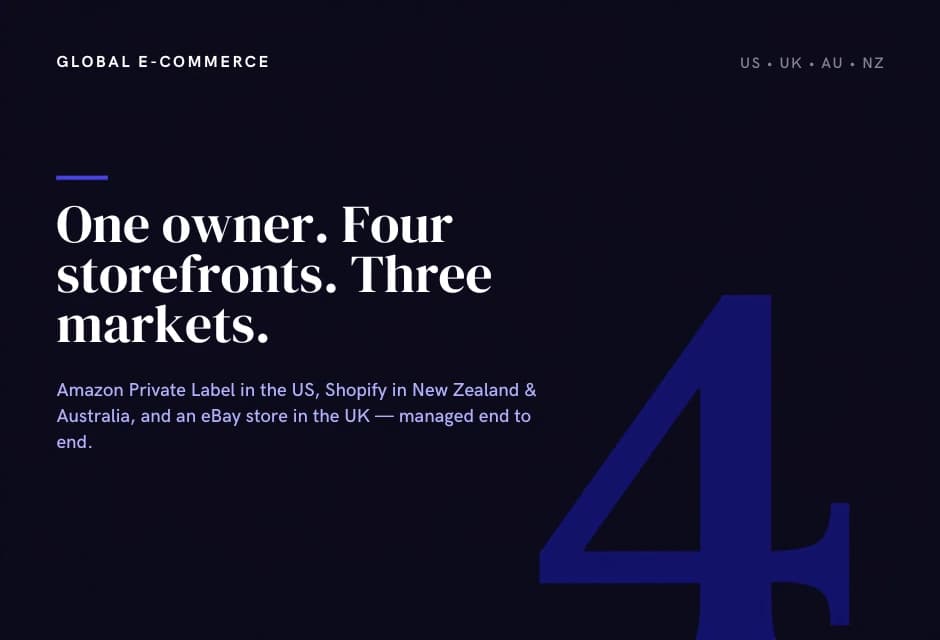
Four stores across the US, Australia and New Zealand.
Proof
Second US store hit $35K while still new.
“I had never sold anything online. They set up the stores and ran them. I put the money in and stayed out of the way.”
How we delivered it
The journey, architecture, and product surfaces behind the results.
Late 2024: first store, Amazon private label US
Started with a single market and a single model, so that if the thesis was wrong it would be wrong cheaply. Product research came first and took the longest, because on private label the product choice is most of the outcome.
By June 2025: $30,000 a month in net profit
Seven months from zero to a store clearing $30,000 net monthly. That was the point the model stopped being a hypothesis.
Expansion: Australia and New Zealand
Two new markets, two different models. Own inventory in Australia for control over stock and fulfilment. Dropshipping in New Zealand to test categories without tying up capital.
A second US store
The real test of any playbook is whether it works the second time with a different product. It reached $35,000 a month in net profit while still new.
June 2026: $175,000
Four stores, $175,000 in net profit, and a typical month rather than a record one.
Before you book the call
Questions about this one
Is $175K a month typical, or their best month?
Typical, not a peak - the case study specifically notes June 2026 was an ordinary month, not a record one.
Would this work without a lot of capital for inventory?
Two of the four stores used owned inventory; the New Zealand store used dropshipping specifically to test a category without tying up capital first. Which model fits depends on how much capital and risk you want to carry - we'd scope that on the call.
How much of this was luck versus a repeatable process?
The second US store reached $35,000 a month in net profit while still new, on a different product than the first. That's the detail meant to argue this is a repeatable process, not a one-off.
Next Step
Same problem, different company?
Bring the bottleneck. In 30 minutes you leave with the order of operations - whether or not you hire us.