
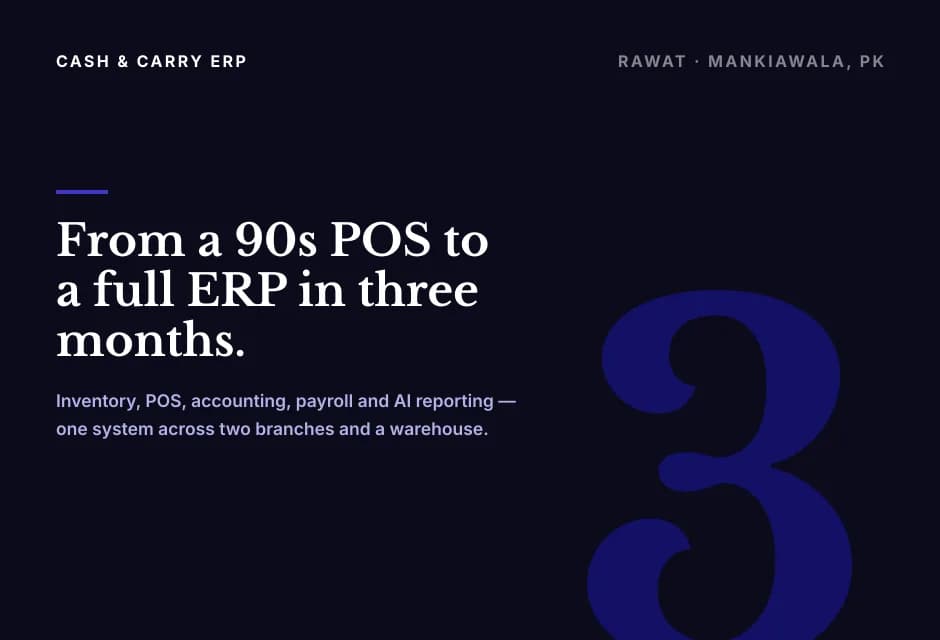
From a 90s POS to a Full ERP. Three Months. Four Sites.
SuperSaver ran two cash & carry outlets on a point of sale built in the 1990s. It could ring up a sale. Everything else was happening somewhere else.
- Client
- SuperSaver Cash & Carry, Rawat & Mankiawala
- Tech Stack
- Custom ERP and POS, multi-location inventory, double-entry accounting, HR and payroll, AI reporting and invoicing automations, website inventory sync
- Services Delivered
- Development
Results at a glance
The numbers first. The build underneath.

The challenge
The point of sale worked, in the narrow sense that it could ring up a sale. It had been built in the 1990s, and it had never been built for this business.
- It was generic software written for any retail shop, and SuperSaver is not one shop.
- The result is a familiar one: a multi-location business being run on single-location tools.
Read the detail
It was generic software written for any retail shop, and SuperSaver is not one shop. It is two branches, a warehouse and a head office that all need to be looking at the same stock. None of that existed. Transfers between the warehouse and the branches were coordinated by hand. Purchase orders were raised and chased outside the system. Accounting sat somewhere else entirely, disconnected from what was happening on the sales floor.
The result is a familiar one: a multi-location business being run on single-location tools. The client could tell you what had been sold. They could not tell you what was moving where, what was owed, or what was coming in, without someone assembling the answer by hand first. That is not a reporting inconvenience. It is the difference between running the business and reacting to it.

The outcome
A full ERP live across both branches, the central warehouse and head office
- Built and deployed in three months, replacing a point of sale that had been in service since the 1990s
- Stock transfers, indent requests and purchase orders raised inside the system instead of by hand
Read the detail
Eight modules on one login: inventory and warehouse, POS, accounting, vendors and customers, pricing and shrinkage, HR and payroll, analytics, and AI automations
Accounting posted from the sales floor, so there is no longer a second set of books to reconcile
Website inventory synced live against warehouse and branch stock
Report and invoice generation handled by automations rather than staff time
3
months from kickoff to live
4
sites on one system

Our solution
We did not patch the old system. Over three months we built a new ERP from the ground up, designed around how a cash & carry actually runs day to day.
- Inventory and warehouse.
- Point of sale.
- Accounting.
- Vendors and customers.
- Price and shrinkage control.
- HR and payroll.
Read the detail
Inventory and warehouse. One stock picture across the warehouse, head office and both branches. Stock transfer requests, indent requests and auto-generated purchase orders replaced the manual back-and-forth. When stock runs low the system raises the order itself rather than waiting for someone to notice.
Point of sale. Fast at the counter, but wired directly into inventory and accounting behind it, so every sale moves stock and posts to the books as it happens rather than at the end of the day.
Accounting. Built in rather than bolted on: chart of accounts, general ledger, trial balance, profit and loss, balance sheet, cashbook and bankbook, payables and receivables aging, and GST reports. One set of numbers, so there is nothing to reconcile at month end.
Vendors and customers. Who they buy from, who they sell to, and where each account stands: balances, history and terms held against the record instead of in somebody's memory.
Price and shrinkage control. Custom pricing rules and shrinkage tracking, which matters more here than in most retail. Margins in a cash & carry are thin and stock moves fast, so shrinkage is where the money goes if nobody is watching it.
HR and payroll. Staff attendance and payroll inside the same system rather than running as a separate process alongside it.
Reporting and automation. Analytics built for planning rather than record-keeping, AI automations handling report and invoice generation, and a live inventory sync to the client's website so what is shown online is what is actually on the shelf.

Before
- A point of sale built in the 1990s for any retail shop
- Stock transfers between warehouse and branches coordinated by hand
- Purchase orders raised and chased outside the system
- Accounting disconnected from the sales floor

After
- One stock picture across two branches, the warehouse and head office
- Transfer requests, indent requests and auto-generated purchase orders
- Every sale moving stock and posting to the books as it happens
- Reporting and invoice generation handled by automations
Coverage
Both branches, the central warehouse and head office on one system.
Speed
Built from scratch and deployed in three months.
One source of truth
Accounting posted from the counter, not reconciled after it.
“We were running two branches on a POS from the 1990s. They replaced it with one system for the shops, the warehouse and the office. Three months and we were live.”
How we delivered it
The journey, architecture, and product surfaces behind the results.
Discovery
We mapped how the business actually runs: what moves between the warehouse and the two branches, who raises a purchase order, and where the numbers were being assembled by hand. The gaps were not in the point of sale itself. They were in everything the point of sale never touched.
Build or buy
Off-the-shelf retail software would have covered the counter and left the multi-location, indent and shrinkage problems exactly where they were. That is the narrow case where building is the cheaper answer over the life of the system, and it is the only reason we recommended it.
Build
Three months. Inventory and warehouse first, because every other module depends on the stock picture being right. Then the point of sale on top of it, then the full accounting stack, then HR, payroll and the reporting layer.
Automation and sync
AI automations wired in for report and invoice generation, and a live inventory sync to the client's website so online stock reflects real stock rather than yesterday's count.
Live across four sites
Deployed to both branches, the central warehouse and head office, with transfers, purchase orders and daily accounting running through the system from the first day.
Before you book the call
Questions about this one
We're not a cash & carry - does this apply to our retail business?
The specific modules were built for cash & carry, but the underlying problem - one stock picture across multiple locations instead of each site running as its own island - applies to most multi-location retail. We'd scope what maps to your business on the call.
How long did a full ERP across four sites actually take?
Three months, replacing a point-of-sale system that had been in place since the 1990s.
Do you migrate our existing records, or start from zero?
Data migration is scoped as part of the build - mapping what exists in the old system before cutover, not a from-zero restart.
Next Step
Same problem, different company?
Bring the bottleneck. In 30 minutes you leave with the order of operations - whether or not you hire us.